

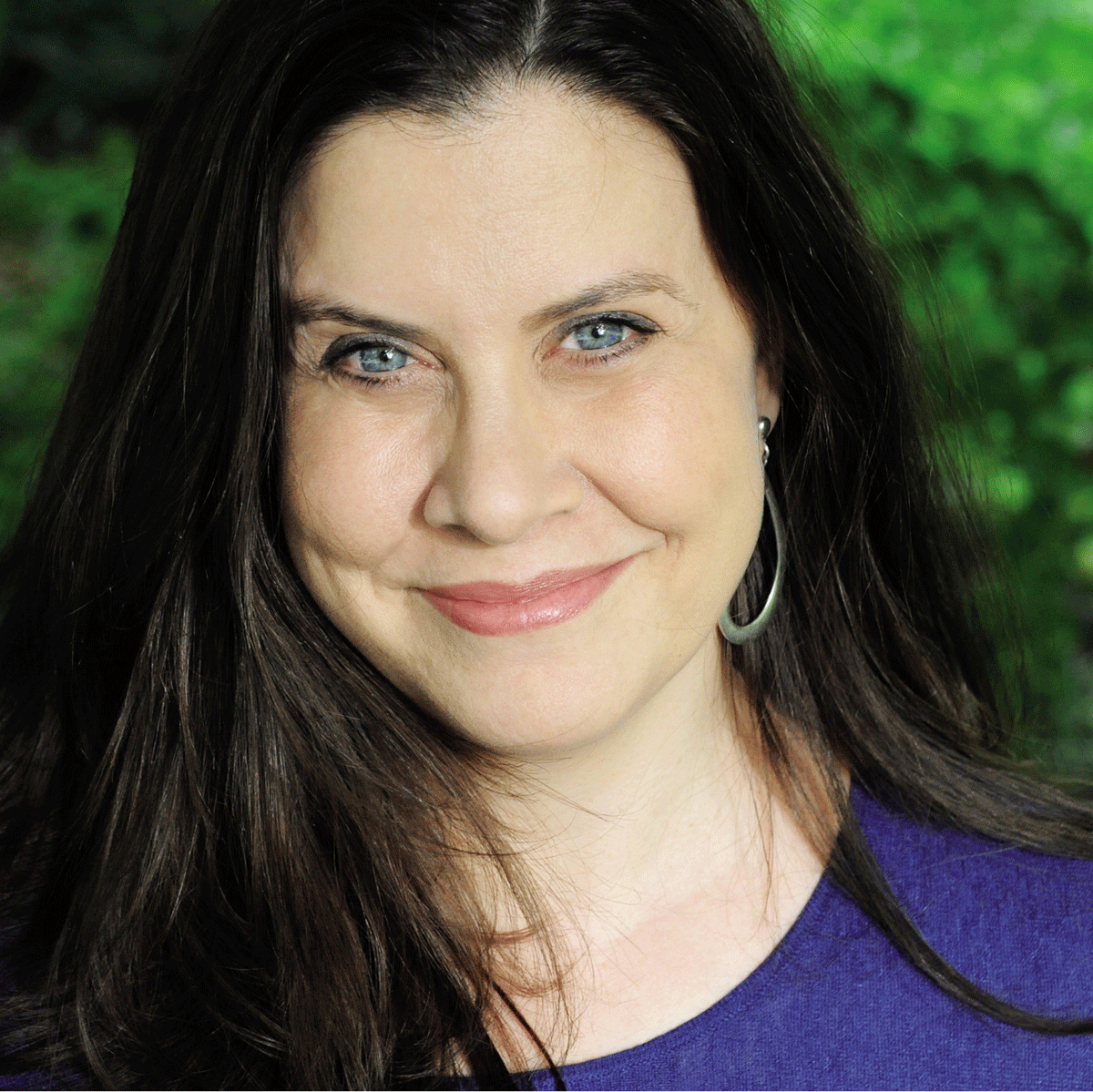
In this era of iPhone cameras and social media, imagine being the only person on the planet to film a defining moment in history. How long would it take such a priceless piece of footage to reach the masses? Twelve seconds? Twelve minutes? What if it weren’t shown to the rest of the world for 12 years?
Such was the initial journey of the double 8-millimeter film that Abraham Zapruder captured on Nov. 22, 1963, in downtown Dallas’ Dealey Plaza. As chronicled in Twenty-Six Seconds—written by Zapruder’s granddaughter, Alexandra—the home movie of John F. Kennedy’s assassination would take on a life of its own.

Though Abraham, who died in 1970, initially sold all rights to Life magazine, Time Inc. returned the film to the family for $1 in 1975. Seventeen years later, under the JFK Records Act, the Zapruder film became government property as a record of the assassination; an arbitration hearing later set its value at $16 million, which was paid to the Zapruder heirs. Along the way, the film influenced everything from media ethics and popular culture to copyright law and conspiracy theories.
Fifty-four years later, Alexandra believes, it also remains “a wound from which the country will never heal.”
“Even now, when I talk about my grandfather’s film or our experience, people want to tell me where they were when it happened, how it felt, how traumatic it was,” she says. “There’s a strong need to share that.”
What struck you about your grandfather’s presence of mind—his character—in dealing with the frenzy surrounding his film after the assassination?
There are moments in life when you’re tested. Some people rise to the occasion, some don’t. He did. He called upon all the things he needed to handle this situation with a lot of grace, humanity and composure. Not only did he physically hold himself steady while filming this [tragedy], but he handled everything that happened in the days after and made sound judgments. It’s really astonishing, and it’s a testament to who he was.
Based on what you learned, do you think the film changed Abraham over the last seven years of his life?
I think he experienced a trauma, and it stayed with him. I wouldn’t go as far as to say it ruined the rest of his life; he had grandchildren he loved, he had a wife and children that he adored. But I think it was there, it was a shadow.
He definitely had recurring nightmares, and he was of a generation where he didn’t get help. In today’s world, he would’ve seen a psychiatrist and worked through it. Being a 58-year-old Russian immigrant in the mid-1960s, he didn’t do that. He just kind of white-knuckled it. He got through it the best he could, but it makes me sad because I think it’s something that remained painful for him.
One of the book’s themes is the idea of the Zapruder film as a burden—and not just for your family. Why did it carry weight in so many different ways?
Because it was the first of its kind, it was constantly raising questions that people were not prepared to answer. It challenged Life magazine and members of the federal government and the arbitration panel. People had to contend with this object that I thought of at times as a lightning rod. It was so in-demand, so magnetic.
But it was also anti-magnetic, in a way. For those who had to deal with it, it could be repulsive. It brought up feelings and realities that were painful and difficult. It’s kind of like, be careful what you wish for. If you get your hands on the Zapruder film, you might find it causes more problems than it solves.
Can you imagine what would happen in today’s culture if someone had such footage?
In some ways, we have these kinds of moments all the time now. The ubiquity and accessibility of such images, in a weird way, has normalized them. And it’s devalued them. I feel like my grandfather’s film was the first of its kind, but it didn’t take long for it to be the last of its kind too. … It was 12 years before the assassination was shown as a film to a national audience (on “Good Night America” with Geraldo Rivera in 1975). Our impulse today to share first and ask questions later is one of the things that made writing the book so interesting.
How did your father view the film after the family reacquired it in 1975?
In some ways, I think it was even more of a burden for my dad. He had many, many more decisions to make—with much higher stakes. Unlike my grandfather, my father wasn’t accorded a general grace by the public. People felt sorry for my grandfather. My dad, on the other hand, was portrayed as the hotshot boutique Washington lawyer who was out to make a buck. Nothing could have been further from the truth.
Because he had too much dignity to defend himself, I think he shouldered a lot. It’s not that he was altruistic about the film, but he grappled with it. He tried to find a balance to be practical but also honor my grandfather’s wishes, be responsive to the needs of the public, and be respectful of the Kennedy family’s privacy and discretion.
Most of all, it was an unwanted burden. He didn’t like it. He thought it was weird that people were so obsessed about it; he felt there was something unseemly about the fascination with this violent moment. It was all very uncomfortable for him.
Where do you fall on the conspiracy side of the assassination?
I’m not much of a conspiracy theorist. I don’t think the film conclusively proves either side. However, I’ve been convinced by the Nobel Prize-winning physicist and others who argued that the visual evidence does not show conclusively that the president was shot in the front of the head. It’s perfectly plausible that he was shot three times from the rear by Lee Harvey Oswald. So I tend to believe that it was Oswald from the book depository. Was there an operation behind Oswald? Did he act alone? I have no idea. I don’t think the film proves a conspiracy, but I’m not sure it proves there wasn’t one either.
What did you learn about your family name in writing the book?
I think I understand better why our name is a touchstone in the way that it is. I have two children, and they took my last name. It wasn’t because of the film; at the time my brothers weren’t married, and we wanted to make sure the name would be passed on. But I realize now that we handed them a bigger legacy than I realized at the time. The book made that more clear, but it also made me feel like I had taken a step in defining that legacy for them.
Meet the Author
When: Nov. 28, 7:30 p.m.
Where: Alper JCC, 11155 SW 112th Ave., Miami
What: Zapruder’s presentation is part of the 37th annual Alper JCC Berrin Family Jewish Book Festival.
Contact: 305.271.9000, ext. 268 or 269