

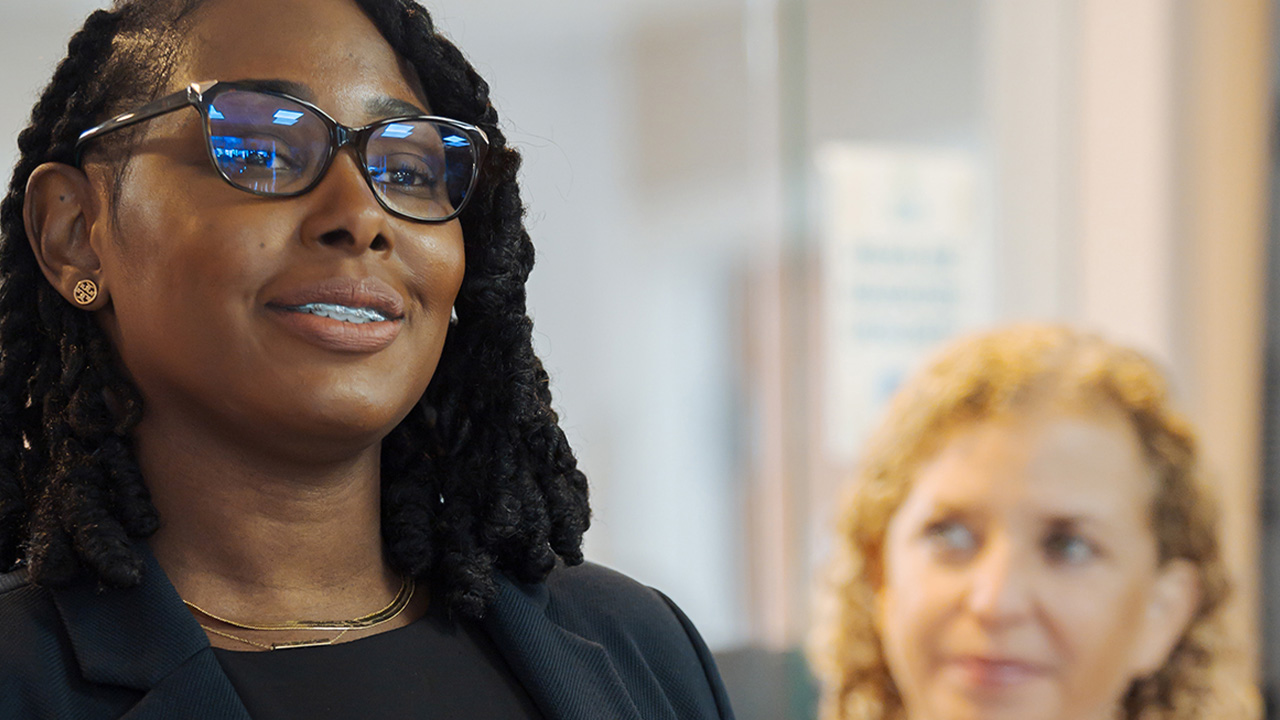
Though her motto is “give a voice to the voiceless”—a nod to her young son, diagnosed with autism at age 3 and non-verbal—the advocacy for which Tracy Joseph is renowned isn’t limited to children with special needs. The community patient navigator at Broward Community & Family Health Center (BCOM) is equally passionate about breast cancer awareness—particularly for the uninsured and underinsured.
The certified behavioral health technician (who earned her master’s in public administration at Barry University) has seen breast cancer journeys up close; both her mother and her childhood friend battled the disease. But, on a day-to-day basis, Joseph also sees women who don’t have access to, or who don’t know about, the resources available—support, especially when it comes to early detection, that can save lives.
It’s no wonder Joseph spoke with such emotion at a recent check presentation that launched the Women’s Health Center at BCOM in Hollywood. It’s a replication of the model originated by Promise Fund of Florida in Palm Beach County, one that, since 2018, has provided breast cancer screening, education and treatment for 20,000 women dealing with “financial and cultural health inequities.”
1) What’s something you see as a patient navigator regarding breast cancer awareness that might surprise women?
Socioeconomically disadvantaged individuals are typically not aware of the resources in their communities, that help is here and available. [At] outreach events, the feedback is typically, “Wow, I didn’t know you were here.”
One of the common barriers to care I encounter as a patient navigator [involves] language. South Florida is a diverse community, but patients who do not understand the need for screenings or the schedule at which they should have them … run the risk of gaps in continuous care. It’s a patient navigator’s responsibility to ensure that no patient gets lost in care.
Breast cancer is a disease that doesn’t discriminate by age. More women detect cancer at a later stage because they didn’t have a mammogram until they reached the qualifying age. By providing education—such as that women should regularly examine their breasts—we [help plant] the instinct to see a doctor if they notice a new lump, thickening or swelling of the breast, an inverted nipple, or any other alarming changes in their breast. They now know what to look for, so they quickly can take the next steps to diagnosis and treatment.
2) Was there anything specific about the cancer journeys of your mother or childhood friend (or both) that dovetails with the efforts The Promise Fund supports?
Centers for Disease Control has a list of identifying risk factors to help prevent breast cancer on its website. Studies have found that, with some risk factors, it’s in our power to change the potential of developing breast cancer; other risk factors, unfortunately, are out of our control. The Promise Fund’s mission is to address those health disparities so that women who can eliminate risk have the tools and resources to take charge of their health. My childhood friend lost her mother to breast cancer at age 5 and learned she had inherited the BRCA mutation from her mother. Contrary to my mother, who does not have the BRCA mutation, she may have had more control in lowering her chances. Factors such as healthy eating and physical activity are simple lifestyle [changes] that can lower your risk.
3) Where are the gaping holes in the health-care system that prompt women to disengage?
I strongly believe in having more engagement between providers and their patients. Patients are more likely to continue treatment if they are educated about the benefits of healthy living through their primary health-care team and the possible outcomes if treatment is missed.
For example, medications typically read “take as prescribed.” Like [many people], I discontinue the treatment once I feel better. [Then, I became educated] that if treatment isn’t completed, I may become resistant to that medication or even regain my symptoms. Once I knew that, I immediately took more interest in taking care of my body, asking more questions and, more importantly, building a relationship with my doctor.
4) How will the $900,100 in federal funding secured (by Congresswomen Debbie Wasserman Schultz) for BCOM impact women in the community?
The mission at BCOM is to provide accessible, comprehensive, high-quality primary and preventive care services to all persons with dignity and respect. The partnership and funding are to address breast and cervical cancer screening disparities in Broward County with the goal of increasing rates of early detection and diagnosis of breast and cervical cancer. This program will provide community screening, primary-care referrals, case management services and health education. BCOM also has secured the official launch of a mammography machine in the near future so that patients are not referred out. These funds truly are making a difference in the community.
5) Do you see parallels between your advocacy on behalf of women and the work you do for children, like your son, with special needs?
Absolutely. Advocating for early detection is a parallel for many different communities that suffer from health disparities. It’s always comforting to know that there are people out there, just like you, who made it through the storm. Hearing those success stories gives a sense of hope, even when the road seems tough or the light at the end of the tunnel seems unreachable.
As a patient navigator, autism mom and breast cancer daughter, finding resources can sometimes be challenging. There seems always to be one or two disqualifying components as it relates to coverage for treatment, whether it’s a couple of dollars over eligibility, or living a mile or two outside the radius of a treatment center. Getting a diagnosis can go many ways. Someone may hit the ground running, while another may need some time to process what’s happening. But eliminating that extra hurdle prior to treatment is what Promise Fund and BCOM have partnered to avoid.