

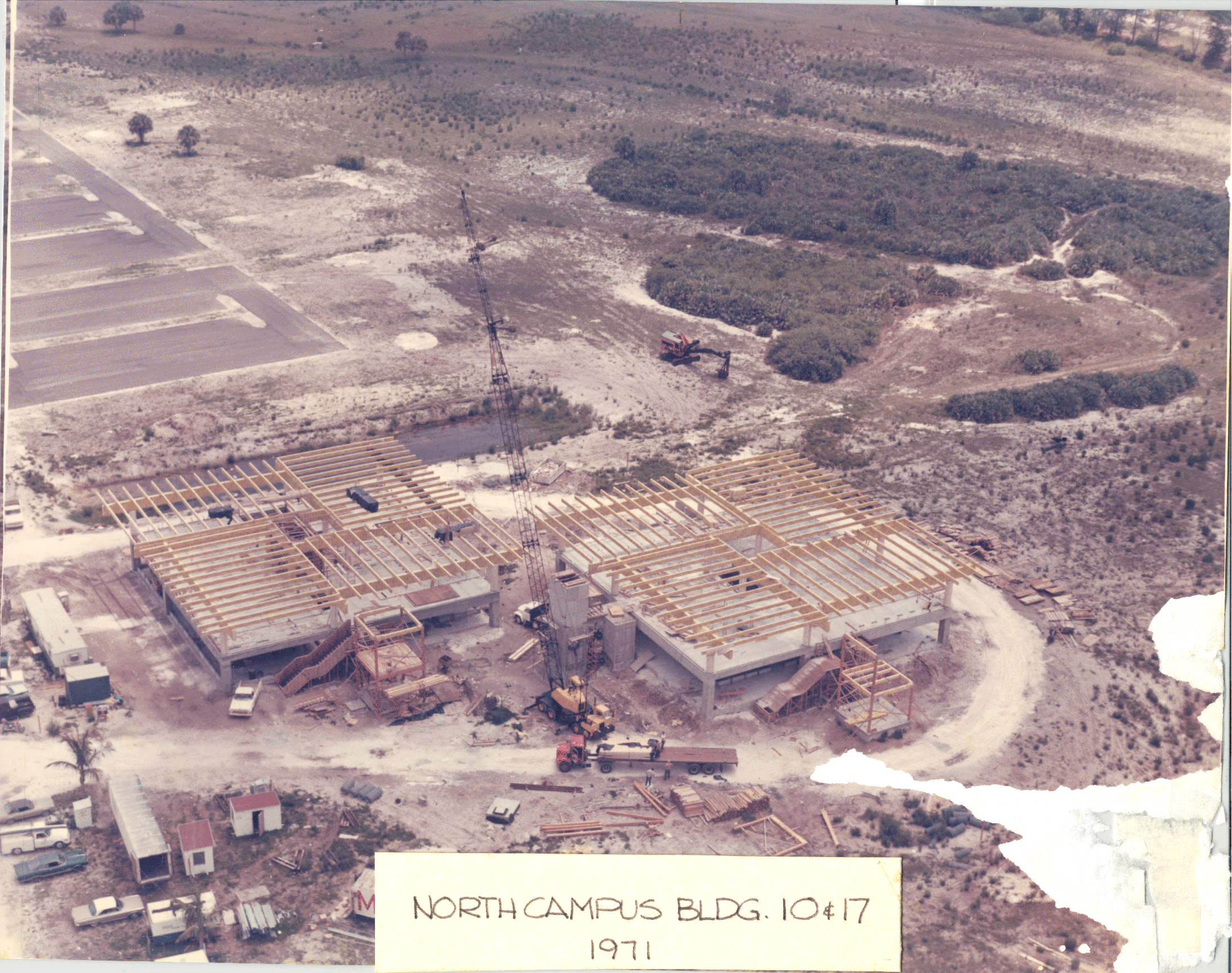
In the late 1960s and early ’70s, the young city of Coconut Creek saw an explosion of growth in education. Coconut Creek Elementary debuted in 1968, Coconut Creek High School opened its doors in 1972, and Atlantic Technical College followed one year later. Another higher-education entity planted roots during this era—Broward College’s North Campus, then known as Broward Community College, which also held its first classes in 1972.
Plans to build a college on the land close to Florida’s Turnpike had been around since 1965, the year a local newspaper quoted school board member A. Wesley Parrish Sr. as saying, “People just haven’t realized that North Broward is growing as fast as it is. In fact, we’ve grown up.”
Though a resident of Delray Beach, assistant professor Trish Joyce saw this growth firsthand. She began teaching at North Campus the year it opened—and she still teaches English classes, literature and creative writing there today. Coconut Creek Lifestyle asked Joyce to share some memories of the campus’ early days.
As part of the minority-retention program, Joyce had the opportunity to build the new canon being taught to English students, something new for the early 1970s.
“One of my students told me that she had never read African-American literature until I introduced it; that was really exciting. [We read] the autobiography of Malcolm X. … Today, you are bringing in multiple perspectives across genders, race—the things that used to divide us so much. The movies we show in film class, the literature we read, they’re far more diverse than when I started.”

Early on, Joyce and other faculty members learned to treat their students like family when then-provost Carl Crawford announced at the opening faculty meeting that he was dubbing the campus the “caring community,” an informal name that Joyce says stuck with the faculty for about a decade.
“When we came back from vacation, every person on campus would stand at that meeting and say the proverbial what I did over my summer vacation. … Student Life is a phenomenal organization here at North, and [they’ve always done] so much. If there was a fundraiser, everybody contributed or participated. We had a state championship basketball team over a period of a couple of seasons, and Student Life would sponsor whoever wanted to go to the tournament games. … If there was a player injured (in any sport), everybody knew that player by name and would check on him or her. ”
Activities beyond the classroom were a huge part of the scene at North Campus. Faculty played tennis together, and there were softball games; as Joyce puts it “in those days, everybody did everything.”
“There would be no classes from noon to 1 because everybody would be sitting on the common green, which was in the center of the campus. [Editor’s note: Today, it’s south, toward the student registration building]. People would sit on the green with their instruments and books. Nobody seemed to worry about the sun back then. There would be either musical performances, demonstrations by faculty and students. … You knew almost everybody on campus, by face if not by name.
“We even had a Thanksgiving dinner for the entire campus. The fellow that coordinated it, Marc Sonnenfeld, insisted that he and his staff at the Writing Center would take care of everything. We would have it the week before Thanksgiving, and it was a three-hour event because not everybody ate at the same time. Everyone from facilities and the security guards, up to the top-level administration, would go. It [lasted] about eight or 10 years.
As the times changed, so did traditional social structures. Joyce and others noticed women were returning to the workforce once their children were in school. Starting in 1976, Joyce and others started a women’s center to meet these students’ needs.
“There was a period when women were coming to Broward College and wanting advice about programs and courses of study and so forth. Some students and I saw this need, and we founded a women’s center. They would establish their bearings, meet people and learn about the programs, workshops and weekly activities.
“At that same time, Broward had a special assistant to the president for women’s affairs, Judith Van Alstyne, and she was one of my mentors. It was phased out once there was that critical mass of ‘returning women’ [also known as] ‘displaced homemakers.’ Thank goodness neither term is used anymore.”

Joyce taught her share of interesting students over the years—perhaps none more so than Brian Warner, who took her creative writing class around 1989. Warner later became better known as shock-rocker Marilyn Manson.
“He had a garage band, and he wore a black trench coat with a Barbie doll chained around his neck. He was a character, even then. He would get up on the desk in the classroom and recite. Because it was creative writing, who was I to say you can’t do that? [She laughs] There was a musical quality to his poetry. There were other musicians in the class, and I always joke he left because he couldn’t stand the competition. In fact, I think he left because he wanted to devote all of his time to his band. But it was fun having him and saying I knew him back when.”