

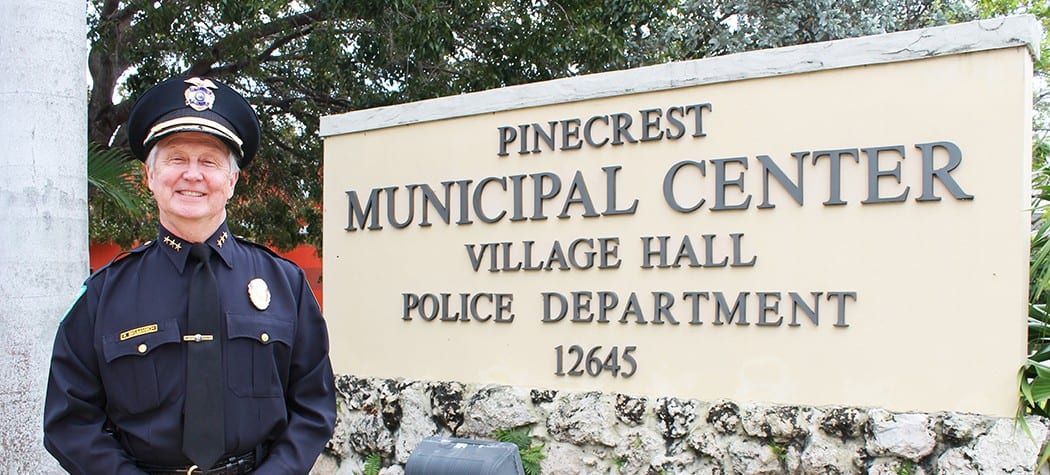
During his tenure on Pinecrest’s police force, Pete Skumanich helped to build the department by interviewing applicants for stability, education, professionalism and ethical standards.
As a Pinecrest police officer since June 1997, and for 27 years with the city of Miami before that, Skumanich represented all these qualities—and much more. After 47 years in law enforcement, he decided it was time to retire, but it was not an easy decision.
“Retirement is bittersweet, but I am excited to start a new chapter in my life,” he says. “It’s sad in one way that it ends, but it’s exciting to start another [stage].”
Skumanich says there wasn’t one driving force in becoming an officer. Certain elements played a part in his decision to joining the force in June 1969, perhaps including one officer he met as a child.
“I looked out the window, and I saw this large person dressed in a uniform,” Skumanich recalls. “It was a motorcycle officer who knew my dad … That kind of sparked something in my memory bank because he looked very professional—he stood out.”
Skumanich served in a variety of positions in the detective bureau, internal affairs and communication before retiring as a captain. Along the way, he received a commendation from Miami mayor Xavier L. Suarez in 1992 for his leadership in handling a hostage situation.
Just when he was thinking of retiring and falling back on his residential contractor license, he heard the new Village of Pinecrest was hiring officers. He started working there in June 1997 as a sergeant. To move up, he earned his bachelor’s degree, and later received his master’s in criminal justice from Florida International University. Along the way, he was promoted to lieutenant, then commander, then deputy chief.
On the eve of his official retirement this month, Skumanich shares some of what he’s learned and what’s next.
1 What was the difference between policing in Miami and policing in Pinecrest?
You have more people in the city [of Miami], and Pinecrest has (upward of 19,000), so that is a significant change. You’re not dealing with one-on-one situations [in Miami], whereas in Pinecrest the type of things you deal with, you have to be proactive about.
You get a call and you talk to the complainant who says, “I wanted to find out why my water is not working.” As opposed to saying, “we don’t deal with that,” you say, “Let me see what your problem is. … Let me see if I can get in touch with the right person, and I’ll give you the telephone number.” This is your customer service, your community service. And once that’s done, you follow up with them to make sure that someone contacted them.
That’s the biggest difference. It’s not just, “It’s a crime, write a report.” You take that extra step—you have to go that extra mile.
2 Of all your different positions, which was your favorite?
For the city of Miami, the one I liked the best was when I was on the mounted patrol. You were closer to the community. You had a specific beat. You met business owners and citizens within that beat. At Pinecrest, I would have to say my experience in being involved in the growth and development [of the department]—the chiefs, including the current one, always relied upon me for things to develop. So that was the most enjoyable thing—knowing that all my experience was beneficial to the growth of the organization.
3 What do officers do behind the scenes that people don’t often see?
Unfortunately, a lot of times on the news, you only see the negative aspects. Seldom do you see officers going out and helping somebody stranded on the side of the road, or staying there to help them. [It’s a] personal approach when we are dealing with individuals in our community—they appreciate seeing that you are doing something and that citizens are not just numbers. We follow up, we contact them. Periodically, officers go back to a resident regardless of the type of incident, whether it be criminal or not criminal, just to see how they’re doing. You don’t see that stuff on TV.
4 What was the best part of working in Pinecrest?
The Village gave me the opportunity to continue my career, and my education, as well as the upward mobility—that really wasn’t my initial goal. Opportunities were there and, when they arose, I took them. I’m greatly appreciative of having been afforded all those opportunities to reach a goal that was not really my intention. And being able to be part of helping start a new department and to grow with it, that was probably the most rewarding of all.
5 What are some of the things you’re going to check off your bucket list?
One of the first things I’m probably going to do is take a deep breath. I’m going to be on permanent vacation now, not just a two-week vacation. If we want to go somewhere, we’ll go somewhere. If not, play it by ear. Which way are you walking? The way I’m headed. We’re anticipating a couple of cruises, visiting friends and relatives throughout the country—and having more time to spend with them and just enjoy life.