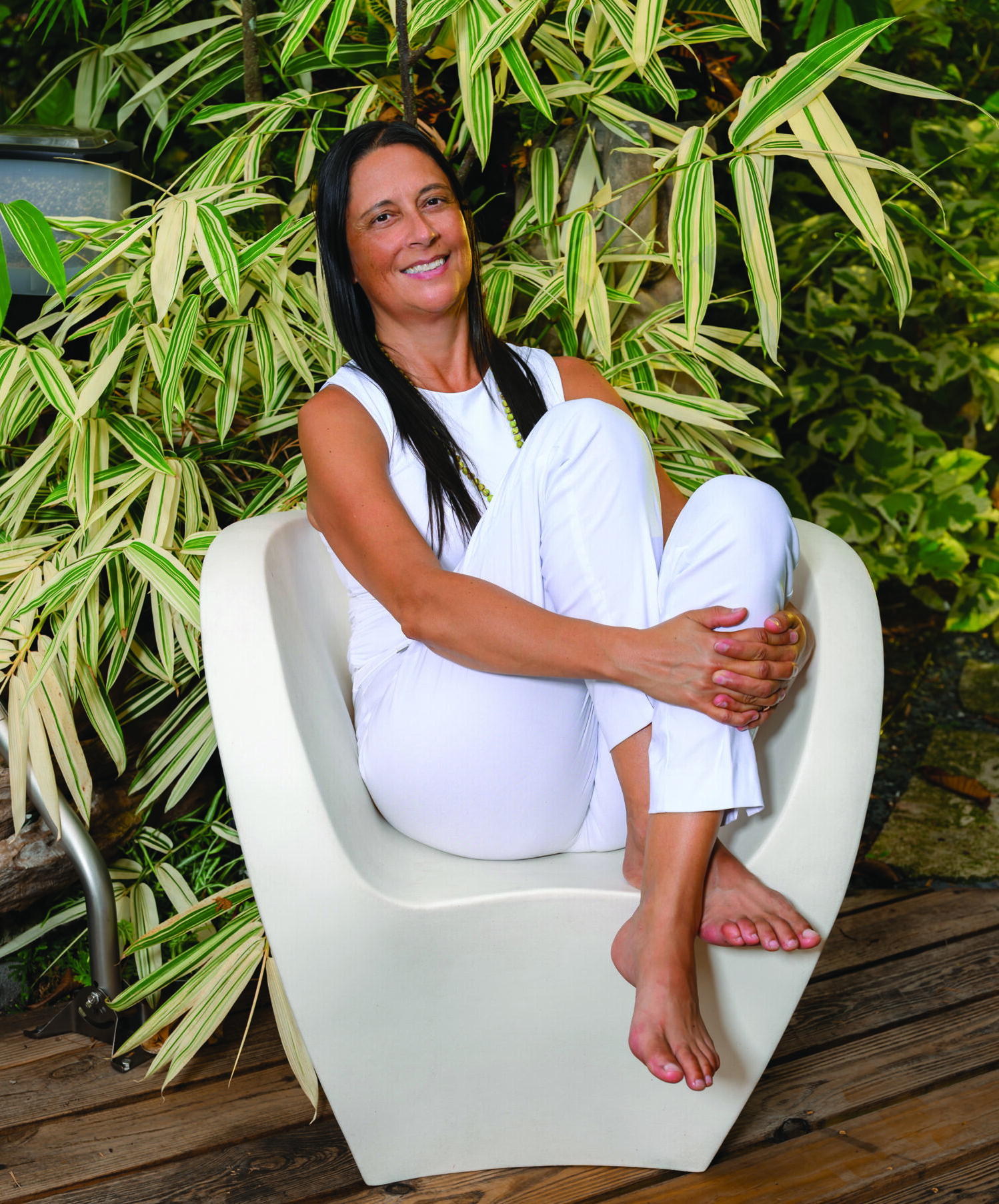


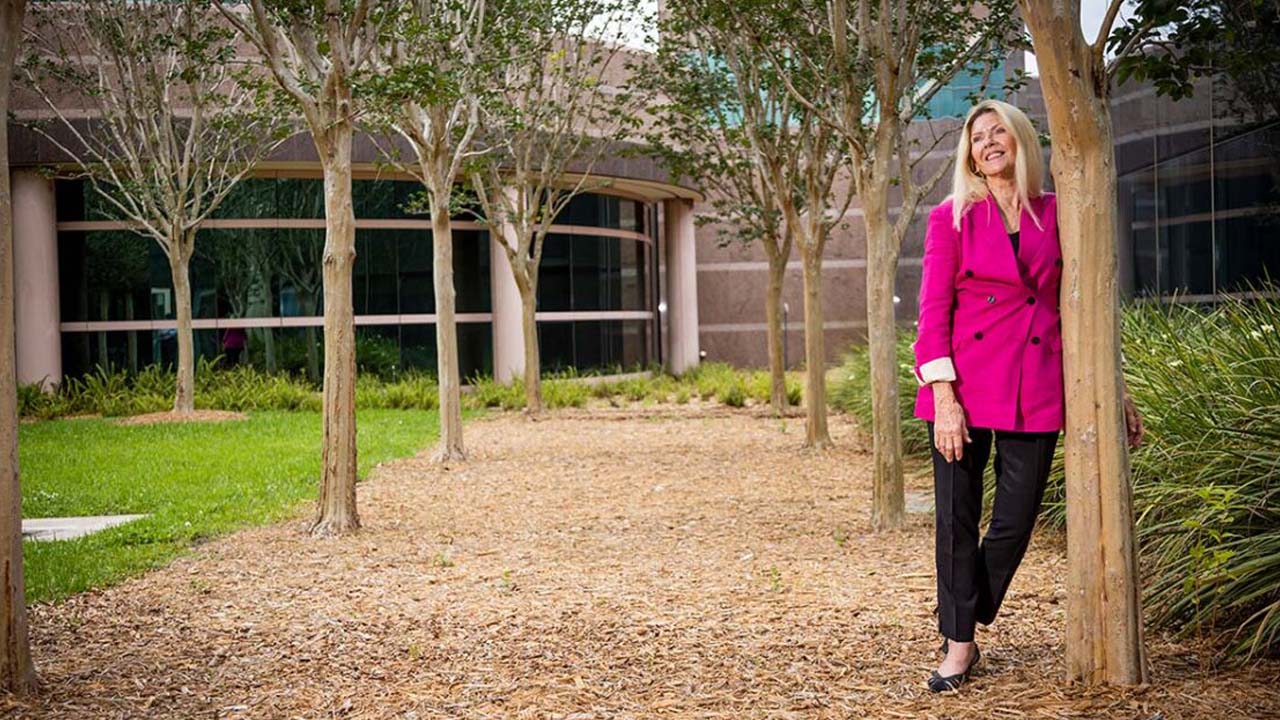
It’s hard not to believe in miracles when you’ve seen as many as Barbara Miller has during her three decades in the medical world of organ transplants, including her current role as a coordinator and manager of the abdominal transplant program at Cleveland Clinic in Weston.
But it’s impossible not to believe in them when you lived with a miracle, one that forever changed not only your life but that of your entire family.
“I do come at this job from a different perspective,” says Miller, who’s been at Cleveland Clinic since 2015. “I’m much more aware of how we interact with our patients and families because I’ve been on both sides of the fence. I know how it feels.”
The road that led Miller to her miracle couldn’t have been less traveled. The native of Cincinnati spent her early nursing years at a pediatric burn unit, the Shriners Burns Institute (since relocated to Dayton as Shriners Children’s Ohio). When she moved to South Florida with her husband, David, in the mid-1990s, there was no pediatric burn center in Broward County. However, there was a fledgling pediatric transplant program at Jackson Memorial Hospital (the main teaching facility at the University of Miami) under the direction of Andreas Tzakis, a visionary in the realm of multivisceral transplants and founder of the Miami Transplant Institute.
In 1997, Miller started as a bedside nurse in the pediatric unit but soon became a transplant coordinator, primarily for liver and intestines.
“You don’t learn about transplants in nursing school; there’s no program for it,” says Miller, who earned her bachelor’s degree at Florida Atlantic University and her master’s at Benedictine College in Kansas. “You learn by doing it.
“Much like victims of burns, undergoing a transplant is a life-altering experience. So, the patients and their families become interwoven for years with our team. That appealed to me. But it also was the idea that we can take horrible tragedy and turn that into a miracle for someone else. In their darkest times, families will be so selfless and donate their loved one’s organs. And that person lives on through the recipient.”
Three years after Cleveland Clinic recruited Tzakis in 2012 to a create a world-class abdominal transplant program, Miller left her position as transplant program director at Lee Memorial Hospital in Fort Myers to join his team in Weston.
In her role as transplant coordinator (liver and kidney), Miller is called on to wear multiple hats as part of the patient journey. It begins with a detailed evaluation process that determines whether the person is an appropriate transplant candidate. Though Cleveland Clinic is on track to do as many as 200 kidney transplants in 2023, organs don’t grow on trees. Indeed, as Miller notes, the number of people who need organs has grown exponentially over the past five years, while donor numbers have remained the same. Last year, Cleveland Clinic launched a living donor program—where a friend or family member donates a kidney or a portion of their liver (which regenerates)—to help mitigate the challenge. “It’s still small in numbers, but we’ve had great outcomes,” she says.

In the meantime, the onus is on a village of personnel—non-clinical staff, nurses, transplant coordinators—to vet candidates, a process that includes an extensive psychosocial evaluation. Part of the final determination involves the patient’s ability to serve as a good steward of the organ.
“With liver recipients, they need to be abstinent from alcohol or drugs for at least six months,” Miller says. “Also, does the candidate have co-morbidities [the presence of two or more diseases] that will prevent them from living a life of better quality? We want to make sure that what we’re offering to a potential recipient will improve their quality of life or help them live longer.”
When an organ does become available, approved transplant candidates obviously have their own questions—including about the donor. But the hospital can’t give out information that would identify the donor, beyond generalities (like age range) and whether that person indulged in high-risk behaviors, which a recipient deserves to know.
“We do have recipients who try to learn more personal information about the donor,” Miller says. “Hopefully, we’ve done a good enough job educating them along the way that they understand that, in reality, it makes no difference if it was a male or female donor. Or what color their skin was. Or what religion they were. It’s a healthy organ. And it’s a good one for you.”
Of the qualities that most endear Miller to co-workers—as well as to patients and families that stay in touch with her for years after a transplant—none is more evident than her empathy. It’s there when she discusses the stresses that accompany the journey. Am I ever going to receive the organ? Am I going to die before I receive it? Is the organ going to work after the transplant? Will I be able to return to work or take care of my children?
It’s also there when she opens up about the most unexpected chapter in her own story.
Miller was at Jackson Memorial in 2000 when Arnold Palmer Hospital for Children in Orlando transferred an infant named Casey to the pediatric transplant unit. Casey, whose mother was in a jail cell when she delivered her, entered the world with her intestines on the outside of her body. Roughly 1 in 2,000 babies each year are born in the U.S. with the birth defect, called gastroschisis; it’s caused by a hole in the abdominal wall near the belly button. Other organs, including the stomach and liver, sometimes exit the small opening.
At the time, one of Miller’s three daughters (she also has a son) was volunteering at the pediatric transplant unit. In that sense, history had repeated itself. As a child, Miller accompanied her mother on her volunteer work at an orthopedic hospital for children in Cincinnati. She knew at age 5, because of those trips, that she would become a nurse.
Now, Miller’s daughter was calling her every day imploring her to come see this remarkable infant. But Mom already had connected with Casey.
“We’d be making the rounds with the doctors, the room would be full, and Casey’s little eyes would zero in on me,” Miller says. “From there, I started coming in to see her before work. I was so in love with her. I’m thinking, my husband will never go for this. We’re older. We already have four children [teens at the time]. But I made my husband come in to see her. And he fell in love with her too.”
The Millers fostered Casey and then adopted her. Casey spent the first 18 months of her life in the hospital. She had her first transplant surgery with Dr. Tzakis the day that she turned 1. She would undergo two multivisceral transplants (liver, intestines, stomach, pancreas), a separate liver transplant and countless other procedures.
At age 1 1/2, Casey finally came home with the Millers. She required a tracheostomy tube and ventilator machine for breathing, and a gastrojejunostomy tube for feeding.
“The ventilator blew out our electricity the first night,” Miller recalls with a chuckle. “We’re thinking, ‘What have we done! We’re not even going to make it through the first night.’
“But she became the light of our lives. There were so many things she experienced because of those transplants. They said she’d never walk. We were at a birthday party one day, and they had a big bubble machine. And she just took off toward the bubbles. They said she’d always have a tube and that she’d never be able to talk. She ended up taking it out on her own. She didn’t say a lot. But you always knew what she meant and what she wanted.”
Casey lived to age 6. She died in 2006 from complications following a transplant surgery.
“She had about two years total that were just wonderful,” Miller says. “We were in and out of the hospital the rest of the time. She was the bravest little girl you’ve ever seen.”
Two years ago, Miller’s husband died. They were married 37 years. Looking back, she says the impact Casey had on their later years together, and on their older children, was profound.
“She sparked something in all of us. We became much closer as a family. Even now, she’s so much a part of us. The lessons that Casey taught us are so much greater than anything we ever could have given her.
“She’s the most miraculous thing that ever happened to us.”
Photography by Eduardo Schneider